
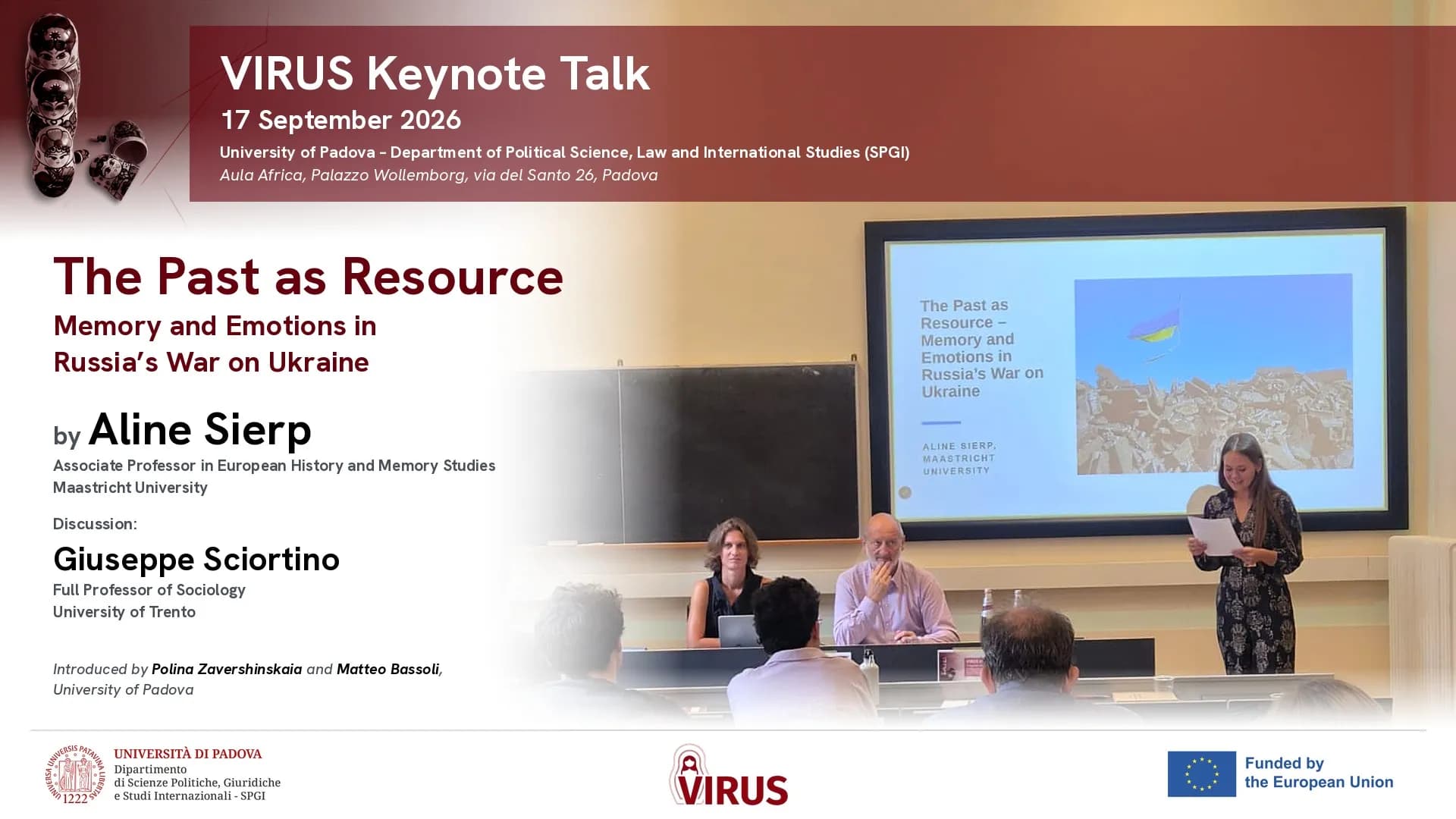
On September 17, 2026, the first VIRUS Expert Talk, “The Past as Resource: Memory and Emotions in Russia’s War on Ukraine” by Aline Sierp (Maastricht University), was held at Palazzo Wollemborg, University of Padova, and streamed online.
The event opened with a welcome to the participants by Polina Zavershinskaia, Principal Investigator of VIRUS, who thanked the Department of Political Science, Law and International Studies (SPGI) for supporting the workshop and introduced the keynote speaker, Aline Sierp (Maastricht University), and the discussant, Giuseppe Sciortino (University of Trento).
Aline Sierp is an Associate Professor in European History and Memory Studies and the current Head of the History Department at Maastricht University. She is co-founder of the Memory Studies Association and of the Council for European Studies’ Research Network on Transnational Memory and Identity in Europe, and co-editor of the Berghahn book series Worlds of Memory. Her research covers collective memory after experiences of human rights violations, questions of identity, and European integration.
Giuseppe Sciortino is Professor of Sociology at the University of Trento and, alongside Jeffrey Alexander and Peter Kivisto, one of the prominent thinkers of Civil Sphere Theory — a framework on which VIRUS relies to trace the transformations of political regimes in comparative perspective. He writes on social theory, international migration, and the social dimensions of sexual and erotic life. He is the author of Great Minds: Encounters with Social Theory (with Gianfranco Poggi, Stanford University Press, 2011) and co-editor of The Civil Sphere: A Concise Introduction (with Peter Kivisto, Polity, 2026).
Why this talk, and why now
Aline Sierp’s talk — “The Past as Resource: Memory and Emotions in Russia’s War on Ukraine”, based on her article — and the discussion with Giuseppe Sciortino that followed are central to VIRUS.
When it comes to excessive violence, and to Russia’s aggression against Ukraine in particular — its provocation, its legitimation, and the reactions to it — a norm-based understanding alone cannot give the full picture of the actions taken by different agents during the invasion.
Emotions, and the narrative frames that stimulate them, offer a very promising but still understudied perspective. Emotions are often treated as a secondary, irrational by-product; culturally shaped as they are, they are nevertheless political and an essential part of how decisions and actions are formed.
The VIRUS team is therefore very glad that this semester will be devoted to the role of emotions in politics and their influence on political decisions regarding the invasion — and that this discussion could open with Aline Sierp’s keynote.
Beyond the emotional work of historical memory in EU foreign policy decisions on Russia’s aggression, Sierp also brought in the comparison between 2014 and 2022 — a comparison discussed at length at the project’s kick-off, and one that is much needed when talking about the Russian invasion.
Emotions and memory in the European Parliament: the shock of 2022 (Aline Sierp)
The political use of history is usually associated with autocrats’ abuse of it. Sierp looks at democracies, which also use the past for present purposes — the EU is no exception: “the use of history and sometimes abuse of history is certainly a feature that you can find almost everywhere.” Her starting point is a puzzle. In 2014, when Russia annexed Crimea, the EU hesitated. In 2022, despite diverging interests and contested memories, the EU’s reaction to the full-scale invasion was unprecedented: “The response of the EU in this case was rapid, was uniform, and it was very determined.” As mentioned above, there is a broad consensus that interests and norms alone cannot fully explain the difference.
Sierp analysed European Parliament debates in the two months after each attack. In 2014, MEPs spoke cautiously, in the shadow of the First World War centenary. References remained vague: “The path of the previous century must not be repeated,” warned one MEP quoted by Sierp.
In 2022, the tone changed radically. High Representative Josep Borrell, as Sierp recalled, told the chamber: “It makes me sick to think of the historical analogy between these events and the start of the Second World War.” She observed that MEPs now drew on their own biographies and national war experiences — memories “much hotter” than in 2014, partly, she suggested, because Ukraine was by then seen as part of the “European family”. The resolution of 1 March 2022condemning Russia’s aggression passed with overwhelming support. After the Bucha massacre, political tensions and accusations increased. Her conclusion: under a crisis perceived as existential to the EU’s values, “memory and its emotional baggage temporarily stopped being ideological and allowed [the EU] to speak with one voice.”
Memory as a prop: who stages the drama? (Giuseppe Sciortino)
Giuseppe Sciortino opened the discussion with a confession: discussing the paper was “a bit of a problem” — he agreed with most of it. He even radicalised its premise: explanations based on interests and norms alone are, in his experience, insufficient — “There is always something more.” The real question is how memory, emotion and salience combine: “What makes the ingredients work?”
His criticism, the sociologist said, probably comes from a different tradition. First, he sees memory and symbols not as the meaning of political action but as props in a drama, where actors court audiences with every tool at hand. Here he invoked Vilfredo Pareto: in Sciortino’s summary, human beings use symbols and values “as accounts that justify actions which are decided on other ground”. Cynical? “Probably interactionally less cynical than it appears,” the discussant said. Caught by the unexpected, politicians try things out: “I can imagine them and their ghostwriter desperately trying [to] work out something to say.”
Sciortino’s second reservation was empirical. The annexation of Crimea, where some actors had long toyed with the idea of secession, looked in Western eyes like a limited land grab rather than an attempt to destroy a state — and, moreover, Putin “did everything in 2014 for playing it low”. In 2022, by contrast, he dramatised everything — from the build-up at the border to the long column outside Kyiv — and Europe responded just as dramatically. His provocative question — at a time when the same historical references are being used against support for Ukraine — was: “Will it [European unity] last?”
Hope for European unity?
Did the unity last? “No, it didn’t. Was it effective? No, it wasn’t,” Sierp admitted, sharing Sciortino’s pessimism: four years on, the war continues. Yet the self-declared “eternal optimist” drew a lesson: “If the sense of threat is very strong, I think then decisions can be taken that usually would be unthinkable. So that gives me hope despite everything else.”
On this note, after a short round of questions from the floor and online, the Scientific Supervisor of VIRUS, Matteo Bassoli, closed the discussion, underlining the importance of the topic in 2026, when Mario Draghi once again stressed the need for European cohesiveness and called for this moment of danger to be used to advance European integration.
The full recording of the first VIRUS Expert Talk can be accessed in the Multimedia section of the project website.